
Medically reviewed by Dr Amol Bhanushali, thoracic and chest surgeon | 9 min read
A tension pneumothorax is a collapsed lung where air keeps leaking into the chest but can’t get out, so pressure builds until it squashes the lung, shifts the heart and blocks blood returning to it. It’s a life-threatening emergency. The immediate treatment isn’t surgery: it’s releasing the pressure with a needle or a chest drain. Surgery usually comes later, if the air leak won’t stop or the pneumothorax is likely to return.
Key insights
- It’s about pressure, not size: a tension pneumothorax is dangerous because air is trapped under pressure, not just because the lung is collapsed.
- Minutes matter: it can kill quickly, which is why emergency teams decompress first and image later in an unstable patient.
- The needle doesn’t always work: a 2025 meta-analysis found needles failed to reach the chest cavity in about a third of imaging measurements.
- Surgery prevents the next one: an operation is usually about stopping recurrence or a persistent leak, not about the emergency itself.
If you’ve had one
Ask your team what caused it, whether a CT shows blebs or bullae on the lung surface, and what your personal risk of another episode is. That conversation, not the emergency, is where the decision about surgery belongs.
Most people have never heard of tension pneumothorax until it happens to them or someone they love. It can follow a road accident or a stab injury. It can happen to a patient on a ventilator. And occasionally it starts as an ordinary collapsed lung, in a tall young man or a long-time smoker, that turns dangerous.
If you’re reading this after an emergency, you probably have two questions. What actually happened? And will I need an operation? Let’s take both in order.
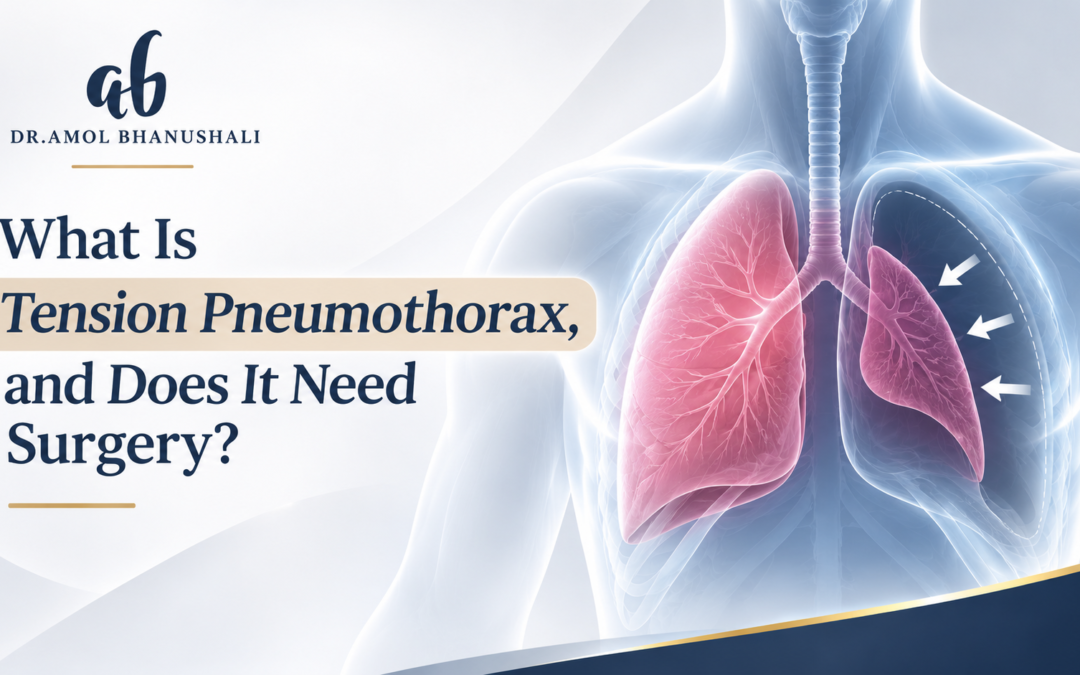
[IMAGE: simple medical illustration showing a normal chest beside a tension pneumothorax, with the collapsed lung and the heart and windpipe pushed to the opposite side. Caption: In tension pneumothorax, trapped air pushes the heart and windpipe away from the affected side.]
What is tension pneumothorax?
Tension pneumothorax is a pneumothorax in which air enters the space around the lung with every breath but can’t escape, acting like a one-way valve. Pressure rises in that side of the chest, collapsing the lung, pushing the heart and major vessels sideways and reducing blood flow back to the heart. Without treatment, it can cause cardiac arrest.
Simple vs tension pneumothorax
| Feature | Simple pneumothorax | Tension pneumothorax |
| Air in the chest | Yes | Yes, and building up |
| Pressure | Low | High and rising |
| Heart and windpipe | In place | Pushed to the other side |
| Blood pressure | Usually normal | Falls |
| Urgency | Urgent | Emergency, minutes count |
Why the one-way valve matters
When the leak only lets air in, every breath adds more. That’s what turns an uncomfortable collapsed lung into a life-threatening one.
What causes tension pneumothorax?
The most common causes are chest injuries, such as rib fractures or penetrating wounds, and patients on breathing machines, where positive pressure can force air through a small leak. It can also develop from a spontaneous pneumothorax, especially in people with underlying lung disease.
Trauma
Road accidents, falls and stab wounds can tear the lung or chest wall. Trauma teams actively look for tension pneumothorax in every serious chest injury.
Ventilated patients
Pressure from a ventilator can rapidly convert a small leak into tension. Intensive care teams watch for sudden drops in oxygen and blood pressure.
Spontaneous pneumothorax
Tall, thin young men and smokers can develop pneumothorax from small blebs on the lung surface. People with COPD, cystic lung disease or TB scarring are at higher risk, and their pneumothorax is more likely to become serious.
What are the warning signs?
Warning signs include sudden, severe breathlessness, sharp chest pain on one side, a racing heart, low oxygen levels, falling blood pressure, distended neck veins and, late on, the windpipe shifting away from the affected side. In someone who’s deteriorating fast, this is a call-an-ambulance situation.
Signs at home
Sudden one-sided chest pain and breathlessness that’s getting worse, not better. Lips turning blue, confusion or fainting are danger signs.
What doctors look for
Absent breath sounds on one side, low blood pressure, rapid heart rate and low oxygen. In an unstable patient, they treat before waiting for an X-ray.
How is tension pneumothorax treated in an emergency?
The emergency treatment is immediate decompression, usually by inserting a needle or cannula into the chest to let trapped air out, followed by a chest drain. Some trauma teams go straight to a finger thoracostomy and drain. Decompression relieves pressure within moments when it works.
Where the needle goes
Guidelines differ, using either the second space between the ribs at the front of the chest or the fifth space at the side. A 2025 meta-analysis found that the chest wall was thinner at the fifth space on the side, and that needles failed to reach the chest cavity in 32.84% of imaging measurements, with longer needles failing less often.
Then a chest drain
A needle is a temporary fix. A proper chest drain is placed to keep air out and let the lung re-expand.
Why surgery isn’t first
Surgery takes time, and someone with tension pneumothorax doesn’t have time. Decompression first, stabilise, then decide what happens next.
When does tension pneumothorax need surgery?
Surgery is usually considered if the air leak persists for several days despite a chest drain, if the lung won’t re-expand, if the pneumothorax returns, if both lungs are affected, or if there’s an underlying lung problem such as large bullae. Certain jobs, like pilots and divers, also lower the threshold for surgery.
The common triggers
- Persistent air leak: the drain is still bubbling after several days.
- Lung won’t re-expand: despite a working drain.
- Recurrence: a second pneumothorax on the same side.
- Both sides: pneumothorax on both lungs, at the same time or separately.
- Underlying disease: large bullae, cystic lung disease or a damaged lung.
- High-risk jobs or hobbies: pilots, divers and others where a recurrence would be dangerous.
What the guideline says about intervention
The 2023 British Thoracic Society pleural guideline moved away from size alone as the trigger for intervention, focusing instead on symptoms and patient factors, and recommends shared decision-making around procedures. Definitive surgery to prevent recurrence is part of that conversation after a pneumothorax.
What a thoracic surgeon looks at
A CT scan to look for blebs or bullae, how the lung behaves with the drain, your general fitness and how disruptive another episode would be to your life.
What does pneumothorax surgery involve?
Pneumothorax surgery is usually done by keyhole VATS: the surgeon removes or seals the blebs or bullae that leak air (bullectomy) and then makes the lung stick to the chest wall (pleurodesis) so it can’t collapse again. Most patients go home within a few days.
| Procedure | What it does |
| Bullectomy | Removes the air-leaking blisters on the lung surface |
| Mechanical pleurodesis | Roughens the chest lining so the lung sticks to it |
| Chemical pleurodesis | Uses a substance like talc to create that adhesion |
| Pleurectomy | Removes part of the chest lining for a firmer seal |
Keyhole vs open
Most operations are done by uniportal VATS through a single small incision. Open surgery is reserved for complex cases.
Recovery
Expect a chest drain for a short time after surgery, walking the same or next day, and a return to normal activity within a few weeks. Flying and diving restrictions depend on what was done.
What affects the cost of a lung operation for pneumothorax?
The lung operation surgery cost for pneumothorax depends mainly on whether it’s keyhole or open surgery, how long the chest drain stays in, any ICU stay, the hospital room category and what your insurance covers. A short, uncomplicated keyhole stay costs much less than a prolonged air leak.
| What moves the number | Why |
| Keyhole vs open surgery | Theatre time, equipment and length of stay |
| Days with a chest drain | Each extra day adds a hospital day |
| ICU or HDU stay | Higher daily charges |
| Room category | Affects many other line items |
| Underlying lung disease | Can make surgery and recovery longer |
| Insurance coverage | Determines your out-of-pocket share |
Ask for the assumptions
Ask what length of stay and drain duration the estimate assumes. If recovery takes longer, that’s usually where the extra cost comes from.
Wrapping up
So does tension pneumothorax need surgery? Not in an emergency. In the first minutes, it needs decompression and a chest drain. Surgery comes afterwards for people with a persistent leak, a lung that won’t expand, a recurrence, underlying lung disease or a job that makes another episode dangerous. That decision should be made calmly, with a scan and a thoracic surgeon.
Dr Amol Bhanushali, a thoracic surgeon trained at Tata Memorial Hospital, treats pneumothorax with keyhole bullectomy and pleurodesis, including uniportal VATS. If you’ve had a collapsed lung and want to know your risk of another, or the drain is still bubbling, book a consultation for a clear plan.
FAQs
What is tension pneumothorax?
It’s a collapsed lung where air keeps entering the chest but can’t escape, building pressure that pushes the heart and vessels aside and reduces blood flow to the heart. It’s a life-threatening emergency.
How is tension pneumothorax treated?
By immediate decompression, usually with a needle or cannula into the chest, followed by a chest drain. Some trauma teams go straight to a finger thoracostomy. Surgery may be considered later.
Does tension pneumothorax always need surgery?
No. Many patients recover with a chest drain alone. Surgery is advised for persistent air leaks, a lung that won’t re-expand, recurrence, both sides being affected, underlying lung disease or high-risk occupations.
What surgery is done for pneumothorax?
Usually keyhole VATS bullectomy, removing air-leaking blisters, combined with pleurodesis to make the lung stick to the chest wall. Most patients go home within a few days of the operation.
Can a pneumothorax come back?
Yes. Recurrence is fairly common after a first spontaneous pneumothorax treated without surgery. Surgery with bullectomy and pleurodesis greatly reduces the chance of it coming back on that side. Stopping smoking helps too.
How much does a lung operation for pneumothorax cost?
It depends on keyhole vs open surgery, drain duration, any ICU stay, room category and insurance. Ask for an estimate that states the assumed length of stay so you can see what could change it.