Aspergilloma, Bronchiectasis & Hydatid Cyst

Chronic lung conditions where timely surgery prevents life-threatening complications

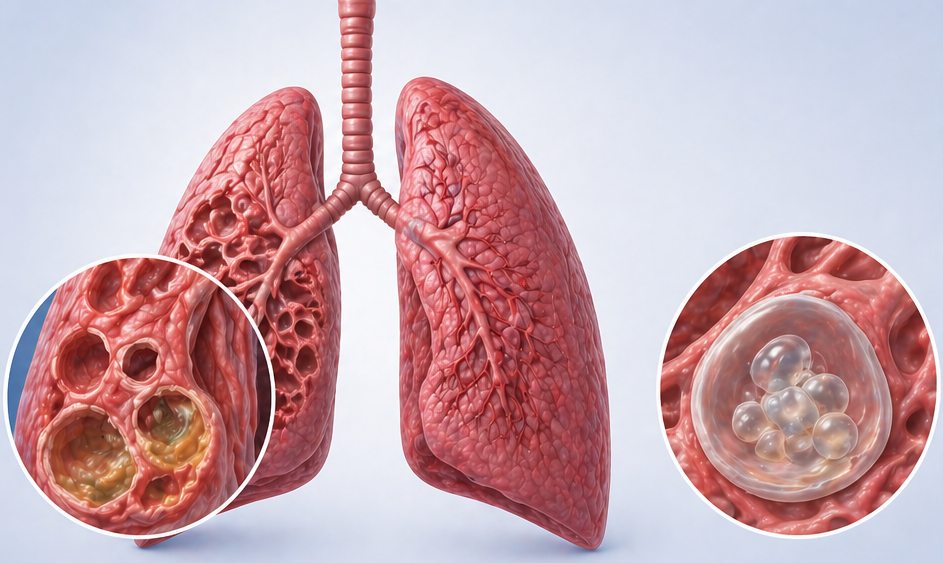
Three distinct but important chronic lung conditions, aspergilloma (a fungal ball in a lung cavity), bronchiectasis (permanent airway dilatation and damage), and pulmonary hydatid cyst (a parasitic cyst of the lung), share a common thread: they each carry risks of major haemoptysis and progressive lung destruction, and each may require surgical intervention when medical management is inadequate.

Aspergilloma

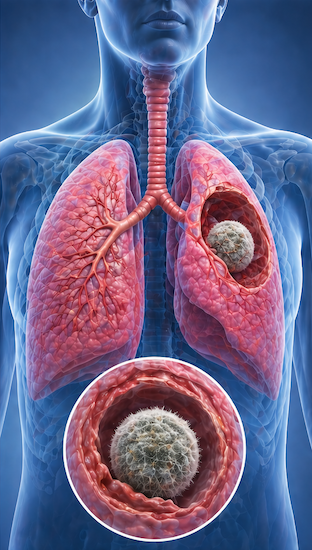
Aspergilloma is a fungal ball (mycetoma) formed by the growth of Aspergillus fumigatus within a pre-existing cavity in the lung, most commonly a healed tuberculosis cavity, but also within bronchiectatic airways, lung abscess cavities, or bullae in emphysema. The fungus colonises the cavity and forms a tangled mass of fungal hyphae, mucus, and cellular debris that gradually enlarges over months to years.

The condition is classified as simple aspergilloma (a single cavity with a relatively intact surrounding lung) or complex aspergilloma (multiple cavities, thick cavity walls, significant underlying lung disease, and bilateral involvement). Complex aspergilloma carries a far worse prognosis and poses a greater surgical risk.

Symptoms of Aspergilloma

Many aspergillomas are asymptomatic for prolonged periods, discovered incidentally on imaging. The most feared complication is haemoptysis, coughing up blood, which occurs in up to 75% of patients and can be massive and life-threatening. The mechanism involves invasion of bronchial blood vessels within the cavity wall by fungal hyphae or by an inflammatory reaction around the cavity. Other symptoms include chronic cough, weight loss, and fatigue. Fever and worsening breathlessness suggest secondary bacterial infection or progression to invasive aspergillosis.
Surgery vs. Embolization for Aspergilloma Haemoptysis

Bronchial artery embolization (BAE) can temporarily control haemoptysis by blocking feeding vessels, but recurrence rates are high (40–60% within one year) because the underlying aspergilloma and cavity persist. Surgical resection, removing the affected lobe or segment, offers a definitive cure with low recurrence of haemoptysis. For fit patients with localised disease and adequate lung reserve, surgical resection is the preferred approach.

Surgical Treatment of Aspergilloma

Surgery for aspergilloma ranges from wedge resection or segmentectomy for small peripheral lesions to lobectomy for larger or centrally located disease. The operation requires meticulous technique to prevent spillage of the fungal ball (which can seed the pleural space, causing pleural aspergillosis). Cavernostomy, surgical opening and cleaning of the cavity without formal resection, is an option for high-risk patients with inadequate lung reserve who cannot tolerate lobectomy. Post-operative antifungal therapy (voriconazole) is continued to prevent recurrence.

Bronchiectasis

Bronchiectasis is the irreversible abnormal dilatation of the bronchi (airways) resulting from chronic infection and inflammation that destroys the airway wall cartilage and supporting structures. It is the final common pathway of many insults to the lung, including childhood pneumonia, tuberculosis, pertussis, cystic fibrosis, primary ciliary dyskinesia, immunodeficiency, and aspiration. The dilated airways pool secretions, become chronically infected by bacteria (most commonly Pseudomonas aeruginosa, Haemophilus influenzae, and non-tuberculous mycobacteria), and generate cycles of recurrent infection and further damage.

Patients suffer from a daily productive cough with large volumes of purulent sputum, recurrent chest infections, haemoptysis (which can be massive), breathlessness, and fatigue. Bronchiectasis has a significant impact on quality of life and, when widespread, leads to progressive respiratory failure.

When Does Bronchiectasis Need Surgery?

Surgery is indicated when the disease is localised to one lobe or segment (allowing complete resection with cure), when recurrent haemoptysis is life-threatening, when medical management fails to control recurrent infections, or when the bronchiectatic segment acts as a septic reservoir continuously seeding the rest of the lung. Careful CT-based mapping of disease distribution and pulmonary function testing is essential to determine the extent of resection and predicted post-operative lung function.

VATS lobectomy or segmentectomy for localised bronchiectasis provides excellent results with low morbidity. For bilateral or diffuse disease, surgery is not curative but may be palliative (e.g., resecting the most diseased segment responsible for repeated haemoptysis). Lung transplantation is the ultimate option for end-stage bilateral bronchiectasis in young patients, particularly those with cystic fibrosis.

Pulmonary Hydatid Cyst

Pulmonary hydatid disease is a parasitic infection caused by the larval stage of Echinococcus granulosus, a tapeworm whose definitive host is the dog. Humans are accidental intermediate hosts, acquiring infection by ingesting eggs excreted in dog faeces, commonly through contaminated food, water, or direct contact with infected dogs. After ingestion, the larvae penetrate the intestinal wall, travel via the portal circulation to the liver (the most commonly affected organ), and then to the lungs (the second most common site), where they form slowly expanding cysts over the years.

The hydatid cyst has three layers: the outer pericyst (host tissue reaction), the middle laminated membrane (the parasite’s outer layer), and the inner germinal layer (which produces brood capsules, scolices, and daughter cysts). Pulmonary hydatid cysts can grow to enormous sizes, 10–15 cm, and produce pressure effects on the surrounding lung.

Symptoms and Diagnosis

Small hydatid cysts are often asymptomatic. Larger cysts cause chest pain, cough, breathlessness, and haemoptysis. Rupture of the cyst into the bronchial tree causes expectoration of clear, salty water and fragments of the germinal membrane (“grape skin” expectoration), virtually pathognomonic. Anaphylaxis can occur if the cyst contents spill into the bloodstream. Rupture into the pleural space causes hydatid empyema and anaphylaxis. Chest X-ray shows a well-defined round opacity; CT confirms the diagnosis and delineates anatomy. Casoni skin test and serology (ELISA) support the diagnosis.

Surgical Treatment of Pulmonary Hydatid

Surgery remains the treatment of choice for pulmonary hydatid cysts, in contrast to hepatic hydatid disease, where PAIR (Percutaneous Aspiration Injection Re-aspiration) is used selectively. The principles of surgery are: prevention of spillage (using hypertonic saline-soaked sponges to isolate the field), evacuation and sterilisation of cyst contents, removal or inactivation of the germinal layer, and management of the residual cavity (capitonnage, suturing the cavity walls together, or marsupialization).

For smaller peripheral cysts, the approach involves careful enucleation of the intact cyst (cystotomy technique). For larger, ruptured, or complicated cysts, lobectomy may be necessary. The VATS approach is increasingly used for accessible cysts in experienced hands. Medical therapy with albendazole is used pre-operatively to reduce cyst viability, prevent recurrence, and treat spillage. Long-term follow-up is necessary because recurrence can occur even years after apparently successful surgery.

Albendazole in Hydatid Disease

Albendazole is given for 1–3 months pre-operatively to reduce cyst pressure and viability, decrease risk of anaphylaxis from spillage, and as post-operative prophylaxis. It is not curative alone for large cysts but is an important adjunct to surgery.

Prevention of Hydatid

Prevention involves deworming dogs, proper slaughterhouse practice, avoiding contaminated water and food, and veterinary public health measures. Communities in close contact with dogs in agricultural settings are at the highest risk.

Aspergilloma, Bronchiectasis, or Hydatid Cyst?

These conditions require specialist thoracic surgical evaluation. Dr. Bhanushali offers expert assessment, surgical planning, and minimally invasive management for all three conditions.

Book Appointment

+91-9920024001

9920024001

What our patients say?

I had an excellent experience with Dr. Amol Bhanushali for my brother's treatment. His approach to the diagnosis and treatment was very reassuring which every patient and his/her family expect. I am thankful to ...
Read More
Vijay Kumar
I had an excellent experience with Dr. Amol Bhanushali for my brother's treatment. His approach to the diagnosis and treatment was very reassuring which every patient and his/her family expect. I am thankful to him and the entire team at the Hospital.
Vijay Kumar
I was admitted this month in Bhanushali Hospital. The nursing staff is very caring and support staff is very prompt. I received very good care from the doctors and the overall experience was excellent. The ...
Read More
Sindhu Kadam
I was admitted this month in Bhanushali Hospital. The nursing staff is very caring and support staff is very prompt. I received very good care from the doctors and the overall experience was excellent. The room was very spacious and was clean and tidy. Food provided is also nice with option for family members to buy as well.
Sindhu Kadam
One of the oldest and best hospitals of Thane. The staff are polite and helpful. You are informed well in advance if there is any change in the appointment timings. Doctors are good. They have ...
Read More
Pradeep Kumar
One of the oldest and best hospitals of Thane. The staff are polite and helpful. You are informed well in advance if there is any change in the appointment timings. Doctors are good. They have a systematic approach towards the treatment and recommend only those tests and medicines which are required. They make you absolutely comfortable and at ease. Charges are also reasonable. Overall a very satisfying experience.
Pradeep Kumar
My wife, Rekha Tejura, had been suffering from TB for the last couple of years. The infection was in her chest and abdomen both. During the treatment with anti-TB medicines,...
Read More
Hemang Tejura
My wife, Rekha Tejura, had been suffering from TB for the last couple of years. The infection was in her chest and abdomen both. During the treatment with anti-TB medicines, abdominal infection decreased but chest infection continued to persist. One of her lungs got covered with a very thick layer of pus and that side lung started to fail. At that time, we decided to go for a different doctor and heard about Dr. Amol Bhanushali. We visited him immediately and started treatment. From the very first visit itself, Dr. Bhanushali responded positively and supported us. The surgery was performed successfully using the latest technology available and my wife’s lung was saved. After the operation, she was fit and fine. I am thankful to Dr. Bhanushali for treating my wife.
Hemang Tejura
My wife, Varsha Garwa, was unwellfor nearly 10 years. She used to a keep coughing a lot and her cough used to contain blood at times. The blood went on increasing...
Read More
Rajesh Garwa
My wife, Varsha Garwa, was unwellfor nearly 10 years. She used to a keep coughing a lot and her cough used to contain blood at times. The blood went on increasing over the last few years. She had developed a fungal ball (aspergilloma) in a cavity in a part of her lung. She was treated by various doctors, however, nothing worked. By a stroke of luck, we came across Dr. Amol Bhanushali’s name. The treatment offered by Dr. Bhanushali was world class. He was very patient and polite. He explained to us everything about the disease and its treatment. He also instilled confidence in us that the surgery would be successful. The Center for Lung Surgery at Dr. Bhanushali Hospital has state-of-the-art infrastructure and has everything under one roof. My entire family is grateful to Dr. Bhanushali for treating my wife and ending her decade long misery.
Rajesh Garwa
My mother, Manjushree Patil, had been suffering from MDR-TB and was on anti-TB drugs for six years. She took treatment from different doctors but there was no respite. Through word of...
Read More
Shweta Patil
My mother, Manjushree Patil, had been suffering from MDR-TB and was on anti-TB drugs for six years. She took treatment from different doctors but there was no respite. Through word of mouth, we came to know about Dr. Amol Bhanushali. During our very first meeting with Dr. Bhanushali, he gave us detailed information about the disease and told us about the treatment. My mother’s left lung was completely destroyed by TB, and the other side was beginning to get affected too, so surgery was needed immediately. We were all very scared but Dr. Bhanushali and his team ensured that the surgery was successful and my mother got rid of TB and recovered completely. We are forever indebted to him for performing the surgery and bringing my mother out of the brink of death, thus giving her a new lease of life.
Shweta Patil