
Medically reviewed by Dr Amol Bhanushali, thoracic and chest surgeon | 9 min read
Most of the time, yes. A hydatid cyst in the lung usually needs surgery, because medicines alone don’t reliably kill the parasite inside a lung cyst, and an untreated cyst can burst into the airway or chest. The standard operation removes the parasite and its membrane while saving as much healthy lung as possible, and it’s followed by a course of albendazole to lower the chance of it coming back.
Key insights
- Surgery is the main treatment for lung cysts: unlike some liver cysts, lung cysts rarely respond well to tablets alone.
- The aim is to save the lung, not remove it: most cysts are dealt with by opening the cyst and closing the cavity, not by taking out a lobe.
- Rupture is the real danger: a cyst that bursts can cause coughing of fluid, infection or a serious allergic reaction.
- Recurrence is low when it’s done well: a large 2025 series reported recurrence in 0.5% of surgically treated patients.
Before you’re told it’s “just a cyst”
A cyst that’s been found by chance on a scan still deserves a proper plan. Ask whether it’s definitely hydatid, how big it is, whether it’s intact, and whether there are cysts in the liver too. Those four answers decide almost everything about treatment.
A lot of people learn they have a hydatid cyst in the most frightening way possible. A chest X-ray for a cough shows a round shadow, the word “mass” appears on the report, and the family starts searching for lung cancer treatment in Mumbai before anyone’s even confirmed what it is.
Then a CT scan suggests it’s a hydatid cyst, a parasitic cyst, not cancer. That’s a relief, but it raises the next question straight away: does it have to come out? Here’s how thoracic surgeons decide, and what the operation actually involves.
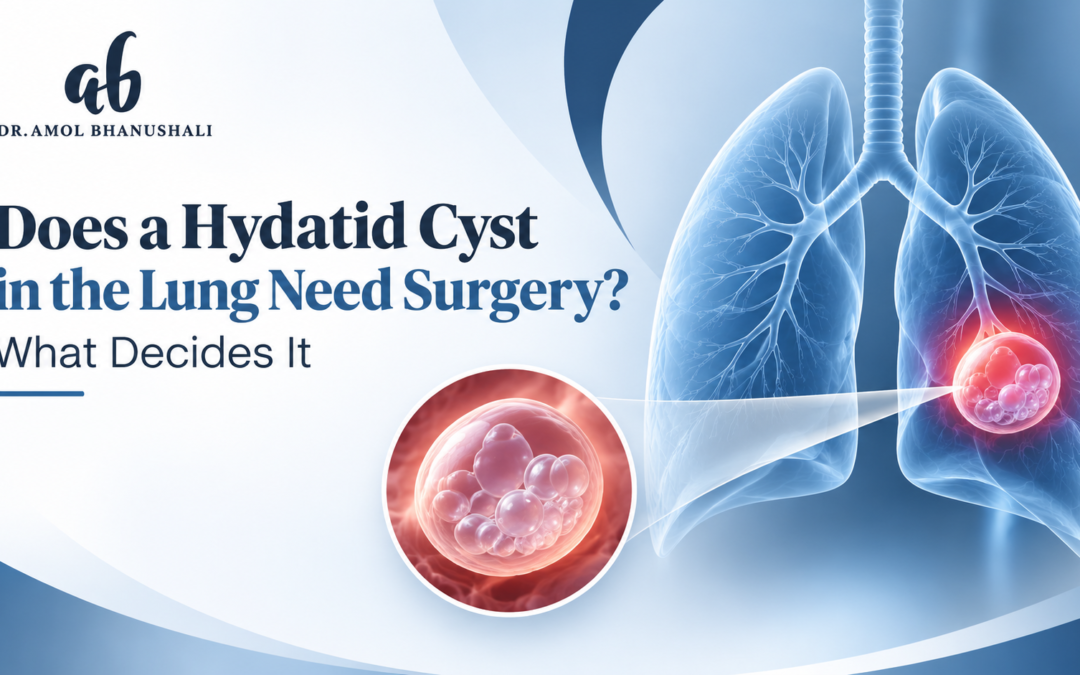
What is a hydatid cyst in the lung?
A hydatid cyst is a fluid-filled sac created by the larval stage of the Echinococcus tapeworm. Humans pick up the eggs from food, water or soil contaminated by infected dog faeces, or through contact with infected dogs. The cysts grow slowly, most often in the liver and lungs.
How common is it?
Cystic echinococcosis is found worldwide, especially in sheep- and dog-raising regions. WHO estimates more than 1 million people are affected at any given time, and India sees cases regularly, including in children.
Symptoms
Many lung cysts cause no symptoms at first. As they grow, people may get a chronic cough, chest pain or breathlessness. Coughing up salty fluid, or what looks like grape skin, usually means the cyst has ruptured into an airway.
Why it can look like a tumour
On an X-ray, an intact cyst is a round shadow, which is exactly what a tumour can look like. CT usually tells them apart, but infections that mimic tumours are a common reason for an urgent thoracic referral.
Why do most lung hydatid cysts need surgery?
Lung hydatid cysts usually need surgery because albendazole on its own often doesn’t kill the parasite inside a lung cyst, and the cyst can keep growing or rupture. Surgery removes the parasitic membrane completely and closes the cavity, giving a definitive cure in most patients.
Why tablets aren’t enough
Albendazole works better on small cysts and in the liver. In the lung, a growing cyst can rupture during medical treatment, and medicines alone have a higher failure rate.
Why waiting is risky
A lung cyst sits next to airways and blood vessels. If it ruptures, it can cause infection, a lung abscess, collapse of the lung or, rarely, a severe allergic reaction to the cyst fluid.
When surgery may not be the first step
Very small, intact cysts, patients too unwell for surgery or people with many cysts in several organs may be treated with albendazole first, with close monitoring. That’s a specialist decision, case by case.
What does hydatid cyst surgery in the lung involve?
The usual operation is cystotomy with capitonnage: the surgeon opens the cyst, removes the parasitic membrane and fluid, closes any small air leaks in the cyst wall and stitches the empty cavity shut. Healthy lungs around it are preserved. Removing a whole lobe is only needed when the lung is badly destroyed.
The steps in plain terms
- The surgeon protects the surrounding chest with swabs soaked in a scolicidal solution, to stop parasite spread.
- The cyst is opened and the fluid and membrane are removed.
- Small airways opening into the cavity are stitched closed.
- The cavity is folded shut with stitches (capitonnage) so no space is left behind.
Open or keyhole?
Many cysts are removed through a small open incision. Selected cysts can be handled by keyhole surgery such as uniportal VATS, depending on size, position and whether the cyst has ruptured.
What a large series shows
A 2025 study of 872 patients treated at one centre found cystotomy and capitonnage were used in 89.7% of operations, with recurrence in 0.5% of surgically treated cases. The most common complication was partial lung collapse, in 5.6%, and prolonged air leak occurred in 1%.
| Operation | What’s removed | When it’s used |
| Cystotomy with capitonnage | Parasite membrane and fluid, cavity closed | Most lung hydatid cysts |
| Cystotomy alone | Membrane and fluid, cavity left open | Less common now |
| Enucleation | Intact cyst shelled out whole | Small, favourably placed cysts |
| Wedge resection | Cyst with a small rim of lung | Small peripheral cysts |
| Lobectomy | A whole lobe | Badly damaged lung or infection |
What happens if a hydatid cyst bursts?
A ruptured lung hydatid cyst can cause sudden coughing of salty fluid or membranes, fever, chest pain and breathlessness, and sometimes an allergic reaction. It often leads to infection in the cavity. Ruptured cysts still usually need surgery, but the operation is often more complex.
Into the airway
Many ruptures empty into a bronchus, and the person coughs up fluid and membrane. Some of the cyst is cleared this way, but infection in the remaining cavity is common.
Into the chest
Rupture into the pleural space can cause a collapsed lung, fluid or pus around the lung, and spread of the parasite.
Allergic reactions
Cyst fluid can trigger allergic reactions ranging from a rash to, rarely, anaphylaxis. Any sudden breathlessness or swelling after coughing up fluid is an emergency.
What’s recovery like after lung hydatid surgery?
Most patients stay in hospital for a few days with a chest drain, which comes out once air leak and drainage settle. They’re usually back to normal activity within a few weeks. Albendazole is often continued after surgery to reduce the risk of recurrence.
Albendazole after surgery
The 2025 series concluded that post-operative albendazole was effective in preventing recurrence. Your surgeon will advise how long to take it and which blood tests to monitor.
Follow-up scans
Periodic imaging checks for new cysts in the lungs or liver, especially in the first couple of years.
Prevention for the family
Deworming pet dogs regularly, washing hands after handling dogs, and washing vegetables will reduce the risk for the rest of the household.
Wrapping up
So does a hydatid cyst in the lung need surgery? In most cases, yes. Medicines alone rarely cure lung cysts, and the risks of rupture make waiting a gamble. The good news is that modern lung-sparing surgery removes the parasite, keeps healthy lungs and has low recurrence, especially with albendazole afterwards.
Dr Amol Bhanushali, a thoracic surgeon trained at Tata Memorial Hospital, treats hydatid cysts, aspergilloma and bronchiectasis with lung-preserving surgery, using keyhole techniques where the cyst allows. If a scan has shown a cyst in the lung, or you’ve been told it might be a tumour, book a consultation and get a clear plan before anything else is decided.
FAQs
Can a lung hydatid cyst be treated without surgery?
Sometimes, for very small, intact cysts or patients unfit for surgery, using albendazole with close monitoring. But most lung cysts need surgery, because tablets alone often don’t kill the parasite and the cyst can rupture.
Is a hydatid cyst cancer?
No. A hydatid cyst is a parasitic infection, not cancer. On an X-ray, it can look like a tumour, but CT and the cyst’s fluid-filled appearance usually make the diagnosis clear.
How is a hydatid cyst in the lung removed?
Usually by cystotomy with capitonnage: the cyst is opened, the parasite membrane and fluid are removed, air leaks are closed and the cavity is stitched shut. A healthy lung is preserved wherever possible.
What happens if a hydatid cyst ruptures?
You may cough up salty fluid or membrane, develop fever, chest pain or breathlessness, and sometimes an allergic reaction. Infection often follows. Seek urgent care, as ruptured cysts usually still need surgery.
Can a hydatid cyst come back after surgery?
It can, but it’s uncommon after complete removal. A large 2025 series reported recurrence in 0.5% of surgical patients, and post-operative albendazole helps lower the risk further. Follow-up scans help catch any new cysts early.
How do people get hydatid cysts?
By swallowing tapeworm eggs from food, water or soil contaminated by infected dog faeces, or through close contact with infected dogs. Deworming dogs, handwashing and washing vegetables reduce the risk.