
Medically reviewed by Dr Amol Bhanushali, thoracic and chest surgeon.
Summary: A collapsed lung, or pneumothorax, happens when air leaks into the space around the lung, causing it to collapse partly or fully. The main symptoms are sudden sharp chest pain and breathlessness. It is most common in tall, thin young men, but can also follow injury or lung disease. Treatment ranges from observation and needle aspiration to a chest tube or keyhole surgery (VATS), with surgery costs in India typically between Rs 2,00,000 and Rs 5,00,000. It can be a medical emergency, so sudden severe breathlessness needs immediate care.
Sudden sharp chest pain and struggling to breathe? A collapsed lung, though it sounds frightening, is a well-understood and very treatable condition.
Also called a pneumothorax, it happens when air escapes into the space around your lung. Knowing the symptoms, causes, and treatment options, including realistic costs, helps you act quickly and make informed decisions.
This guide covers everything you need to know about a collapsed lung.
What is a collapsed lung (pneumothorax)?
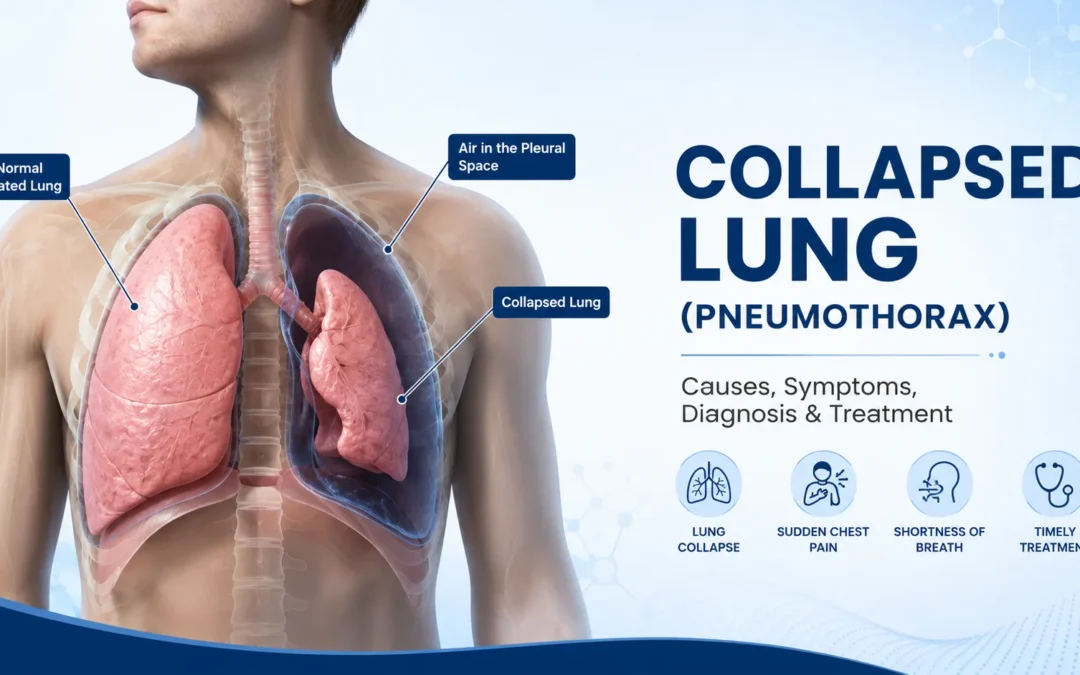
A collapsed lung, or pneumothorax, occurs when air leaks into the pleural space, the area between the lung and the chest wall. This trapped air presses on the lung, causing it to collapse partially or completely. The result is sudden chest pain and difficulty breathing, as the affected lung cannot expand properly.
Normally, your lungs sit snugly against the chest wall and expand freely as you breathe.
When air leaks into the surrounding space, that pressure pushes against the lung and stops it inflating fully. Depending on how much air leaks, the collapse can be small and mild or large and severe.
A large or worsening pneumothorax can become an emergency, which is why sudden severe breathlessness always needs immediate attention.
What are the symptoms of a collapsed lung?
The main symptoms of a collapsed lung are sudden, sharp chest pain on one side and shortness of breath. Depending on the size of the collapse, you may also feel a rapid heartbeat, fatigue, or a bluish tinge to the skin. Symptoms usually come on suddenly, often at rest.
Watch for these signs:
- Sudden sharp chest pain: typically on one side, worse on breathing.
- Shortness of breath: ranging from mild to severe.
- Rapid heart rate: as the body compensates.
- Fatigue or lightheadedness: especially with larger collapses.
- Bluish skin: a sign of low oxygen, needing emergency care.
The sudden onset is characteristic. If you develop sharp chest pain and breathlessness out of the blue, a collapsed lung is one possible cause that needs prompt assessment.
What causes a collapsed lung and who is at risk?
A collapsed lung can happen spontaneously, from an injury, or due to underlying lung disease. Spontaneous pneumothorax often occurs in tall, thin young men when small air blisters on the lung burst. Injury, medical procedures, and conditions like COPD or asthma are other common causes.
The causes fall into a few groups:
| Type | Cause | Common in |
| Primary spontaneous | Air blisters (blebs) bursting | Tall, thin young men |
| Secondary spontaneous | Underlying lung disease | COPD, asthma, cystic fibrosis |
| Traumatic | Chest injury or fracture | After accidents |
| Iatrogenic | Medical procedures | Certain lung or chest procedures |
There is a clear risk profile for the spontaneous type. It most commonly affects tall, thin young men between 15 and 40, with a much higher incidence in men than women. Smoking also significantly raises the risk.
How is a collapsed lung treated?
Treatment depends on the size and severity of the collapse. A small pneumothorax may just be observed, while larger ones need the air removed by needle aspiration or a chest tube. For recurrent or persistent cases, keyhole surgery (VATS) is highly effective at preventing it happening again.
Here are the main treatment options:
| Treatment | When used |
| Observation | Small, stable collapse |
| Needle aspiration | Moderate collapse, to remove air |
| Chest tube | Larger collapse or ongoing air leak |
| VATS (keyhole surgery) | Recurrent, persistent, or high-risk cases |
Surgery is particularly valuable for preventing recurrence. Studies show VATS reduces the recurrence rate dramatically compared with a chest tube alone, which is why it is often recommended for repeat episodes. A minimally invasive VATS approach offers quick recovery and excellent results.
How much does pneumothorax surgery cost in India?
Pneumothorax surgery in India typically costs between Rs 2,00,000 and Rs 5,00,000, depending on the procedure, hospital, and complexity. Keyhole VATS surgery may cost more upfront than a chest tube, but its lower recurrence rate and faster recovery often make it more cost-effective overall.
Here is a rough guide:
| Treatment | Approximate cost in India |
| Chest tube drainage | Lower end of the range |
| VATS (keyhole surgery) | Rs 2,00,000 to Rs 5,00,000 |
| Complex or recurrent cases | Higher, depending on needs |
While VATS can cost more initially, its shorter hospital stay and much lower recurrence rate frequently make it the more economical choice long term. Quality thoracic surgical care in India offers excellent value without compromising outcomes.
Frequently asked questions
Is a collapsed lung a medical emergency?
It can be. A small collapse may only need observation, but a large or worsening pneumothorax can be life-threatening. Sudden severe breathlessness, especially with chest pain or bluish skin, needs immediate emergency care, so never wait to see if symptoms pass.
Can a collapsed lung heal on its own?
A small pneumothorax can sometimes reabsorb on its own with monitoring and rest. Larger collapses need the trapped air removed via aspiration or a chest tube. A doctor decides based on the size and your symptoms, so any suspected collapse should be assessed promptly.
How long does recovery take after a collapsed lung?
Recovery varies with the treatment. Minor cases may resolve in a week or two, while surgery may need a few weeks of recovery. Keyhole VATS surgery generally allows a quicker recovery than open surgery, with most people returning to normal activities within weeks.
Can a collapsed lung happen again?
Yes, spontaneous pneumothorax can recur, sometimes on the same or the other side. Recurrence is much less likely after keyhole VATS surgery than after a chest tube alone, which is why surgery is often recommended for repeat episodes to prevent future collapses.
Who is most at risk of a collapsed lung?
Tall, thin young men are most at risk of spontaneous pneumothorax, especially if they smoke. People with underlying lung conditions like COPD or asthma, and those who have had a chest injury, are also at higher risk. A family history can increase the risk too.
Why choose Dr Amol Bhanushali for pneumothorax treatment
Because a collapsed lung ranges from minor to emergency, and surgery can prevent recurrence, specialist expertise matters, and this is where the practice stands out in Thane.
The clinic provides expert assessment and treatment of pneumothorax, from careful monitoring to advanced keyhole VATS surgery, including Uniportal VATS, that minimises recurrence and speeds recovery. Every patient receives clear guidance on the right treatment for their situation and honest advice on costs.
That expert, minimally invasive approach is what makes the practice a trusted name for thoracic surgery in Thane.
A collapsed lung can be alarming, but it is a well-understood condition with highly effective treatments, from simple monitoring to keyhole surgery that prevents it recurring. Acting quickly on sudden chest pain and breathlessness is what matters most. If you have experienced a collapsed lung or sudden severe chest symptoms, book a consultation today for expert care.