
Medically reviewed by Dr Amol Bhanushali, thoracic and chest surgeon | 9 min read
VATS surgery recovery time is usually a hospital stay of two to five days, a return to light daily activity within one to two weeks, and getting back to most normal routines, including desk work, in about two to six weeks. Full energy and breathing stamina can take two to three months after a lobectomy. Compared with open chest surgery, VATS typically means a shorter stay, less pain and a faster return to physical function.
Key insights
- Keyhole shortens the stay: in the largest UK trial, median hospital stay was 4 days after VATS against 6 after open surgery.
- It speeds early recovery, not everything: physical function was better at four weeks with VATS, but the lung still needs time to adjust.
- The chest drain sets the pace: going home usually depends on when the drain comes out.
- What was removed matters most: a small wedge recovers far faster than a lobectomy, whichever approach is used.
Before your operation
Ask your surgeon which operation you’re having (wedge, segment or lobe), whether it’ll be uniportal or multiport VATS, how long they expect the drain to stay in and what the plan is if your lung leaks air for longer than expected. Those four answers tell you more about your recovery than any general timeline.
When a surgeon tells you your lung operation can be done by keyhole, the relief is real. No big cut, no ribs spread apart. But the next question comes quickly: how long until I’m back to normal? Can I go back to work next week? When can I lift my grandchild?
The honest answer is that VATS speeds up recovery a lot, but it doesn’t erase it. You’ve still had lung surgery. Here’s what the evidence says, what a typical timeline looks like and what tends to slow things down.
What is VATS, and why does recovery tend to be faster?
VATS, or video-assisted thoracoscopic surgery, is keyhole chest surgery performed through one to four small incisions using a camera and long instruments, without spreading the ribs. Because the chest wall is disturbed far less than in open surgery, there’s usually less pain, a shorter hospital stay and quicker early recovery.
Uniportal VATS
Uniportal VATS uses a single small incision. It’s used for many lung resections, biopsies, pleural procedures and some mediastinal operations, depending on the case.
Why rib spreading matters
Much of the pain after open surgery comes from spreading the ribs and the nerves around them. Avoiding that is the single biggest reason VATS recovery feels easier.
How does VATS recovery compare with open surgery?
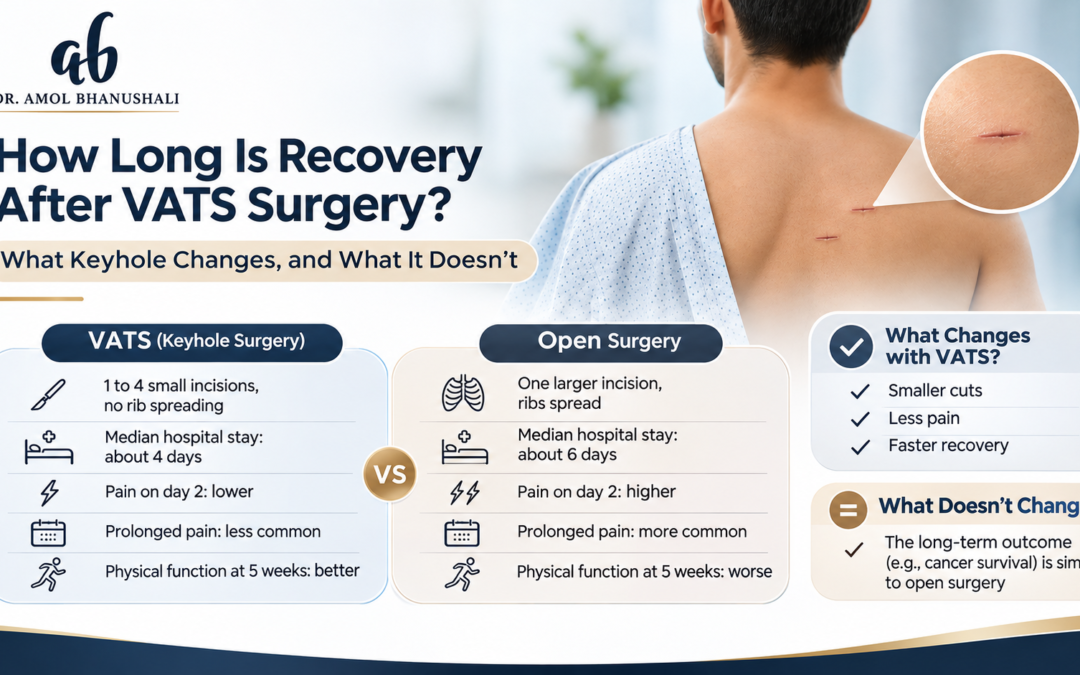
VATS recovery is usually faster than open surgery: a shorter hospital stay, less pain in the first days, less long-term pain and better physical function in the first few weeks. Cancer outcomes are similar for suitable patients.
What the VIOLET trial found
The VIOLET trial randomised 503 patients having lobectomy for known or suspected lung cancer to VATS or open surgery. Physical function at five weeks was better after VATS, and median hospital stay was 4 days with VATS against 6 days with open surgery. Prolonged pain was also less common, while survival was similar.
| Measure | VATS | Open surgery |
| Incisions | 1 to 4 small, no rib spreading | One larger, ribs spread |
| Median hospital stay in VIOLET | 4 days | 6 days |
| Pain on day 2 | Lower | Higher |
| Prolonged pain | Less common | More common |
| Physical function at 5 weeks | Better | Worse |
| Cancer survival | Similar | Similar |
What’s the typical recovery timeline after VATS?
Most people walk the same day or the next day, have the chest drain removed within one to three days and go home within two to five days. Light daily activity returns over the first two weeks, desk work around two to four weeks and heavier activity from about six weeks, depending on the operation.
| Time after VATS | What usually happens |
| Day 0 to 1 | Sitting up, walking with help, breathing exercises |
| Days 1 to 3 | Chest drain usually removed if no air leak |
| Days 2 to 5 | Discharge home for most patients |
| Weeks 1 to 2 | Short walks, light household tasks |
| Weeks 2 to 4 | Desk work, short drives once off strong painkillers |
| Weeks 4 to 6 | Gradually more activity, light exercise |
| Months 2 to 3 | Stamina and breathing largely back after lobectomy |
Wedge vs lobectomy
A wedge resection or pleural biopsy often means going home in a day or two and feeling largely normal within two weeks. A lobectomy takes longer, because the remaining lung has to adapt to doing more work.
What happens in hospitals after VATS?
In hospital, the team focuses on getting you moving early, controlling pain, doing breathing and coughing exercises and removing the chest drain as soon as it’s safe. Modern enhanced recovery programmes aim to cut unnecessary days in bed.
Enhanced recovery
The ERAS Society and European Society of Thoracic Surgeons guideline lists early chest drain removal and early mobilisation among its key recommendations for lung surgery, along with avoiding unnecessary urinary catheters.
The chest drain
A thin tube drains air and fluid while the lung seals. It usually comes out once there’s no air leak and drainage is low. A persistent air leak is the most common reason people stay longer.
Breathing exercises
Deep breathing, coughing with a pillow pressed to the incision and using an incentive spirometer help clear secretions and re-expand the lung.
What slows down recovery after VATS?
Recovery is usually slower with a prolonged air leak, a larger resection such as lobectomy, smoking, COPD or other lung disease, older age, poor fitness before surgery or complications like infection. Pain that stops you breathing deeply can also slow things down.
| Slows recovery | Why |
| Prolonged air leak | Keeps the drain in and you in hospital |
| Lobectomy or larger resection | More lung removed, more adaptation needed |
| Smoking | Poorer healing, more secretions, more infection |
| COPD or emphysema | Lung less able to compensate |
| Low fitness before surgery | Less reserve for recovery |
| Poorly controlled pain | Shallow breathing, risk of chest infection |
Prehab helps
Stopping smoking, walking daily and doing breathing exercises in the weeks before surgery can make recovery noticeably easier. Pulmonary rehabilitation before and after surgery helps many patients.
What should you avoid after VATS?
For the first few weeks after VATS, avoid heavy lifting, strenuous exercise, smoking and flying until your surgeon says it’s safe. Keep walking daily, keep up breathing exercises, and report fever, worsening breathlessness or wound redness promptly.
When to call
- Fever, chills or pus from the wound
- Breathlessness that’s getting worse, not better
- New chest pain or coughing up blood
- Calf pain or swelling
Flying
Your surgeon will advise when it’s safe to fly, usually once a chest X-ray confirms the lung is fully expanded.
Numbness
Some people notice numbness or tingling around the incision for weeks or months. It usually settles gradually.
Wrapping up
So how long is recovery after VATS surgery? Usually two to five days in hospital, one to two weeks to feel comfortable at home, two to six weeks to get back to most normal routines and two to three months for full stamina after a lobectomy. Keyhole surgery genuinely speeds early recovery compared with open surgery, but what’s removed, your lung health and how well you prepare matter just as much.
Dr Amol Bhanushali, a thoracic surgeon trained at Tata Memorial Hospital and formerly an Assistant Professor at KEM Hospital, Mumbai, performs uniportal and multiport VATS at Dr Bhanushali Hospital near Thane station, with enhanced recovery pathways aimed at early mobility and early drain removal. If you’re looking for VATS in Thane or want to know what recovery would look like for your operation, book a consultation.
FAQs
How long does it take to recover from VATS surgery?
Most people stay in hospital two to five days, return to light activity in one to two weeks and get back to most routines in two to six weeks. Full stamina after a lobectomy can take two to three months.
How long is the hospital stay after VATS?
Usually two to five days, depending on the operation and when the chest drain comes out. In the VIOLET trial, median stay after VATS lobectomy was 4 days compared with 6 after open surgery.
Is VATS recovery faster than open surgery?
Yes. VATS usually means less pain, a shorter hospital stay, less prolonged pain and better physical function in the first weeks. Cancer outcomes are similar to open surgery for suitable patients.
When can I go back to work after VATS?
Desk workers often return in two to four weeks. Physically demanding jobs usually need six weeks or more. Your operation, recovery progress and surgeon’s advice should guide the timing. A phased return helps.
Is VATS surgery painful?
There is some pain, but usually much less than after open surgery because the ribs aren’t spread. Pain is controlled with medication, and some people notice numbness around the incision for a few weeks.
When can I fly after VATS?
Usually once your surgeon confirms the lung is fully expanded, often a few weeks after surgery. Flying too early with any remaining air in the chest can be dangerous, so check before booking.