
Tuberculosis(TB) Specialist Doctor in Thane
An ailment that can be treated but requires surgical skills in situations where medicine fails.
Are you experiencing persistent cough, coughing up blood, chest pain, or unexplained weight loss that hasn’t improved with medication? These could be signs of tuberculosis or a TB complication that needs a thoracic surgeon’s opinion, not just continued antibiotics.
Dr Amol Bhanushali is one of the few thoracic surgeons in Thane with a formal TB credential: he serves as Honorary Thoracic Surgeon at the Municipal TB Hospital, Sewri, Mumbai, alongside his private practice at Dr Bhanushali Hospital, Thane. Most TB is managed medically, but complications such as empyema, persistent pleural effusion, destroyed lung, massive haemoptysis, and post-TB bronchiectasis often need surgical intervention once medication alone stops being enough.
Treatment is planned around your specific complication, whether that’s decortication for a trapped lung, pleurodesis for recurrent fluid, or resection for irreversibly damaged lung tissue, always coordinated with your treating pulmonologist rather than in isolation.
If TB treatment isn’t resolving your symptoms, or a complication has been flagged on your scan, book a consultation with Dr Amol Bhanushali in Thane for an assessment of whether surgery is the right next step.
What is Tuberculosis?
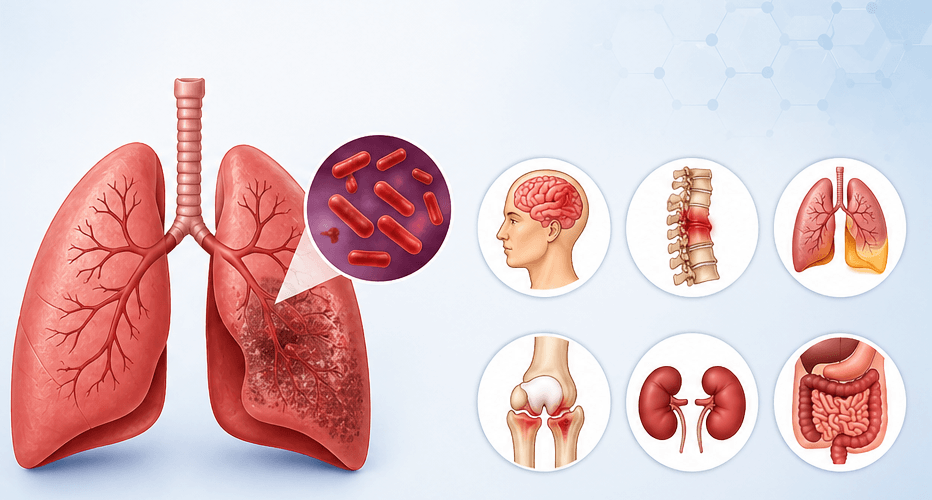
The disease occurs in stages: primary infection and latent TB, active disease, and disseminated disease. The bacteria are first contained in the immune system of the body in a majority of the patients, though they may be reactivated several years later, particularly in cases of malnutrition, diabetes, HIV, or immunosuppressive therapy.
How Does TB Affect the Lung?
The characteristic of pulmonary TB is the creation of granulomas, which are complexes of immune cells that are trying to wall off the bacteria. These granulomas can liquefy (caseous necrosis) as infection progresses, and this results in cavities in the lung. Cavities are very infectious as they contain millions of bacteria and have a connection with the airways.
In a disease that is not treated or allowed to be treated over a long period of time, large parts of the lungs are destroyed. Functional lung parenchyma is replaced by fibrosis and scarring. In more serious instances, specifically in a whole region of the lobe or lung, the tissue may turn into a dysfunctional, fibrotic, and bronchiectatic mass, a phenomenon known as destroyed lung. This causes chronic shortness of breath, frequent infections, and frequent breathing up of blood in such patients.
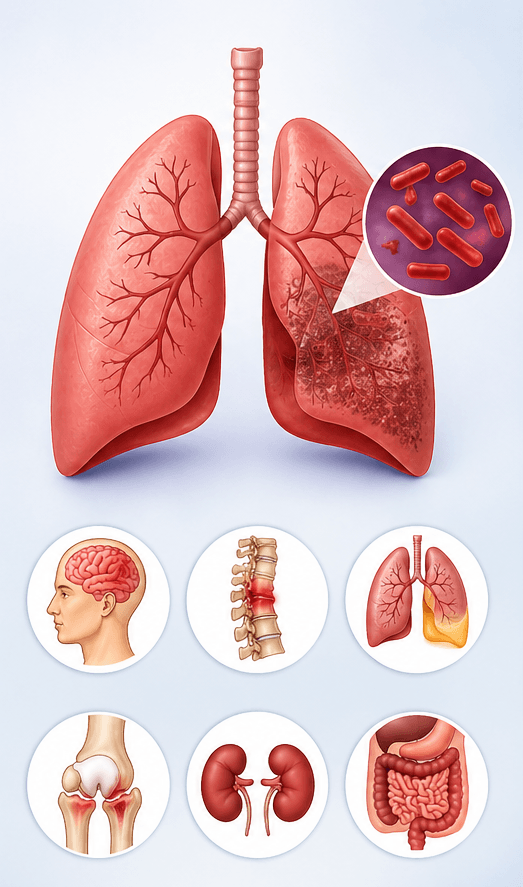
Surgical Complications of TB
Massive HaemoptysisCoughing of blood, which is life-threatening, is usually due to Rasmussen (erosion of a wall of a pulmonary artery close to a hole) or tormented bronchial collateral vessels. Needs an urgent bronchoscopy, angioembolization, or emergency surgery. |
Tuberculous EmpyemaA collection of pus in the pleural space, which has TB. It is often connected with bronchopleural fistula (an abnormal communication of the lung and the chest cavity). Needs to be drained, decorticated, and even more complicated. |
Destroyed LungTotal or partial destruction of a lung through a chronic case of TB. The chronic infection, frequent coughing up of blood, and gradual dyspnea are such factors that surgical removal (pneumonectomy) is required, even though it is very risky. |
Drug-Resistant TB (MDR/XDR TB)In a situation where TB bacteria have developed resistance against the first and second line drugs, surgery could represent the sole opportunity for therapy by eliminating the main focus of the resistant organisms, together with the most appropriate medical therapy. |
Other Complications
When is Surgery Indicated in TB?
What to Expect: Surgical Approach
The use of modern minimally invasive methods (VATS, video-assisted thoracoscopic surgery) is determined by selective use in the case of early or less complex TB surgery, whereas open surgery is the rule in the case of complex, fibrotic, and adherent disease.
Post-Operative Recovery
Consult Dr. Amol Bhanushali
Book Appointment
+91-9920024001
9920024001