Pleural Effusion

Fluid around the lung: understanding why it happens and how surgery helps.

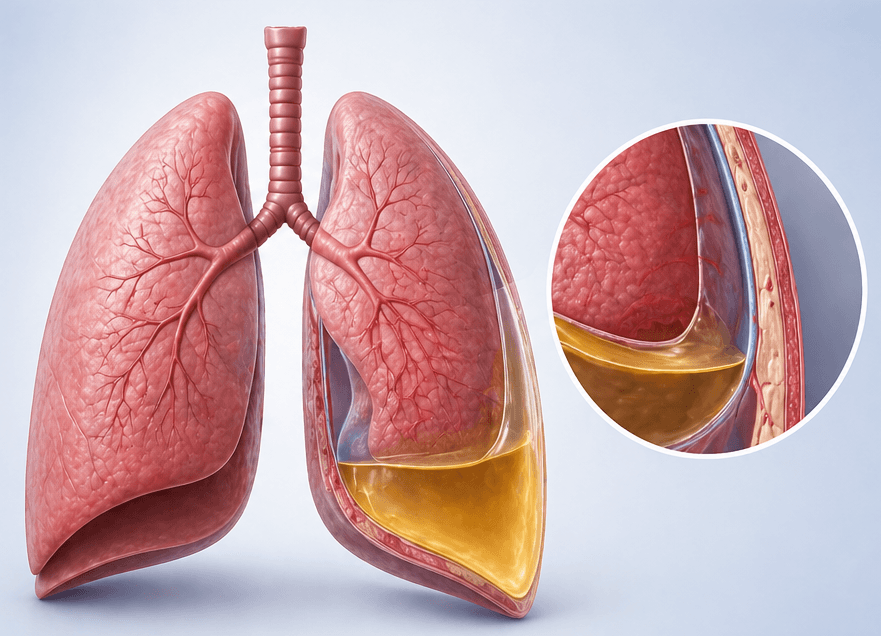
Pleural effusion is a complication of fluid in the interstitial space between the lung and the chest wall. Although small effusions can be treated without surgery, large or recurrent effusions, and especially malignant and complex effusions in the parapneumonia, can be surgically drained, pleurodesised, or otherwise treated to alleviate dyspnea and avoid relapse.

What is the Pleural Space?

Two thin layers, known as the pleura (lungs are covered) and the visceral pleura (covers the lung), and the other one is the parietal pleura (lining the inside of the chest wall), cover the lungs. The space that is found between these two layers is the pleural space, which usually has minimal lubricating fluid, which enables the lungs to glide freely during inhalation. When this space fills with excess fluid, it leads to a pleural effusion, which presses the underlying lung and prevents breathing.

Causes of Pleural Effusion

Pleural effusions can generally be categorized as either transudates, which are precipitated by systemic dysfunctions that change the fluid pressure or protein balance, or exudates, which are precipitated by local inflammation, infection, or malignancy. It is often caused by heart failure, liver cirrhosis, nephrotic syndrome (transudates), pneumonia (parapneumonic effusion), tuberculosis, malignancy, and pulmonary embolism, and autoimmune diseases such as rheumatoid arthritis and lupus (exudates).

Special attention should be paid to malignant pleural effusion. It happens when the cancerous cells implant in the pleura, which is usually due to lung cancer, breast cancer, mesothelioma, lymphoma, and ovarian cancer, and affects fluid reabsorption. Malignant effusion is usually huge, recurrent, and progressive and severely compromises the quality of life.

Empyema: When the Effusion Becomes Infected

The effusion of fluid (around pneumonia) may develop into empyema- raw pus in the pleura. Empyema needs to be drained urgently. In case of untreated hemodialysis, fibrin septa develop, and loculations develop that do not easily drain. A completely formed empyema (fibrothorax) encloses the lung, and to re-expand it, it must be decorticated (surgically removed) to remove the thick fibrous rind.
Symptoms

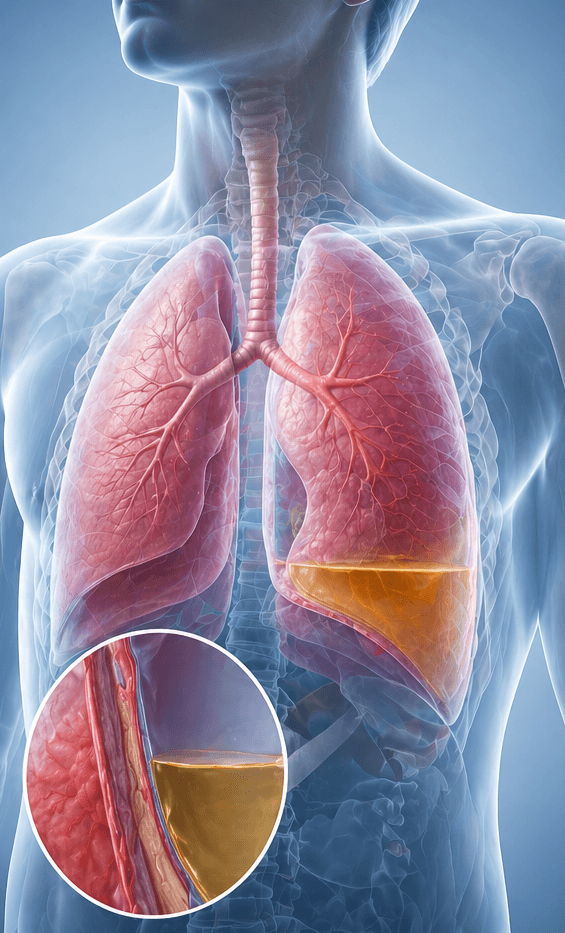
The primary symptom is a gradual weakness of the breath, which is usually accompanied by a dry cough and the feeling of heaviness or pressure in the chest. Mass effusions can result in severe positional pain, the inability to rest in a supine position, and hypoxia. Pleuritic chest pain, sharp pain that is exacerbated by the deep breathing implies the presence of pleural inflammation or infection. Sweats, fever and weight loss are indicators of infection or malignancy.

Diagnosis

The chest X-ray usually presents with flattening of the costophrenic and the lower chest opacification. The ultrasound of chest is the most sensitive equipment that helps identify even small effusions and safe drainage. The effusion is characterized by CT scan of thorax with contrast, determining the loculations, underlying lung pathology and aids in planning intervention. Diagnosis of the drained fluid the underlying cause is determined by analyzing the drained fluid biochemistry, microbiology, cytology, and special tests.

Treatment Options

Thoracocentesis

Aspirin of the fluid using a needle with the help of ultrasound. Diagnostic and symptomatic. No established treatment of recurrent or malignant effusions.

Intercostal Drain (ICD)

A tube through pleural space to drain constantly. Applied to empyema, massive effusions and serves as the initial intervention before the definitive treatment.

VATS Decortication

Minimal invasive surgery to excise fibrous peel which encloses the lung in organised empyema. Enhances complete lung re-expansion and infection resolution.

Pleurodesis

To prevent the recurrence of malignant effusion, chemical ablation of the pleural space (with talc or other agents) is used. Can either be thoracoscopically (VATS) or through drain.

Indwelling Pleural Catheter

Plural catheter An indwelling pleural catheter (IPC) can be used to permit recurring household drainage in patients who are incapable of surgery or in whom the pleura are trapped by the lung (e.g., trapped lung). This will go a long way in enhancing the quality of life and lower the hospitalization of the advanced cancer patients.

Surgical Decortication for Fibrothorax

The untreated chronic empyema or haemothorax results in the fibrothorax, fibrous scarring of the thoracic wall, which limits the expansion of the lungs, resulting in chronic respiratory failure and eventual collapse of the lungs. Decortication, removal of this scar tissue of the lung and chest wall, is a very tedious surgery which, when successful, leads to normal lung function and disappearance of chronic infection. VATS decortication should be used in cases where the disease at hand is in the fibrinopurulent phase; open surgery is required in densely organized chronic fibrothorax.

Struggling with Recurrent or Complex Pleural Effusion?

Dr. Bhanushali provides specialist evaluation and surgical treatment to any form of pleural disease, empyema to malignant effusion.

Book Appointment

+91-9920024001

9920024001

What our patients say?

I had an excellent experience with Dr. Amol Bhanushali for my brother's treatment. His approach to the diagnosis and treatment was very reassuring which every patient and his/her family expect. I am thankful to ...
Read More
Vijay Kumar
I had an excellent experience with Dr. Amol Bhanushali for my brother's treatment. His approach to the diagnosis and treatment was very reassuring which every patient and his/her family expect. I am thankful to him and the entire team at the Hospital.
Vijay Kumar
I was admitted this month in Bhanushali Hospital. The nursing staff is very caring and support staff is very prompt. I received very good care from the doctors and the overall experience was excellent. The ...
Read More
Sindhu Kadam
I was admitted this month in Bhanushali Hospital. The nursing staff is very caring and support staff is very prompt. I received very good care from the doctors and the overall experience was excellent. The room was very spacious and was clean and tidy. Food provided is also nice with option for family members to buy as well.
Sindhu Kadam
One of the oldest and best hospitals of Thane. The staff are polite and helpful. You are informed well in advance if there is any change in the appointment timings. Doctors are good. They have ...
Read More
Pradeep Kumar
One of the oldest and best hospitals of Thane. The staff are polite and helpful. You are informed well in advance if there is any change in the appointment timings. Doctors are good. They have a systematic approach towards the treatment and recommend only those tests and medicines which are required. They make you absolutely comfortable and at ease. Charges are also reasonable. Overall a very satisfying experience.
Pradeep Kumar
My wife, Rekha Tejura, had been suffering from TB for the last couple of years. The infection was in her chest and abdomen both. During the treatment with anti-TB medicines,...
Read More
Hemang Tejura
My wife, Rekha Tejura, had been suffering from TB for the last couple of years. The infection was in her chest and abdomen both. During the treatment with anti-TB medicines, abdominal infection decreased but chest infection continued to persist. One of her lungs got covered with a very thick layer of pus and that side lung started to fail. At that time, we decided to go for a different doctor and heard about Dr. Amol Bhanushali. We visited him immediately and started treatment. From the very first visit itself, Dr. Bhanushali responded positively and supported us. The surgery was performed successfully using the latest technology available and my wife’s lung was saved. After the operation, she was fit and fine. I am thankful to Dr. Bhanushali for treating my wife.
Hemang Tejura
My wife, Varsha Garwa, was unwellfor nearly 10 years. She used to a keep coughing a lot and her cough used to contain blood at times. The blood went on increasing...
Read More
Rajesh Garwa
My wife, Varsha Garwa, was unwellfor nearly 10 years. She used to a keep coughing a lot and her cough used to contain blood at times. The blood went on increasing over the last few years. She had developed a fungal ball (aspergilloma) in a cavity in a part of her lung. She was treated by various doctors, however, nothing worked. By a stroke of luck, we came across Dr. Amol Bhanushali’s name. The treatment offered by Dr. Bhanushali was world class. He was very patient and polite. He explained to us everything about the disease and its treatment. He also instilled confidence in us that the surgery would be successful. The Center for Lung Surgery at Dr. Bhanushali Hospital has state-of-the-art infrastructure and has everything under one roof. My entire family is grateful to Dr. Bhanushali for treating my wife and ending her decade long misery.
Rajesh Garwa
My mother, Manjushree Patil, had been suffering from MDR-TB and was on anti-TB drugs for six years. She took treatment from different doctors but there was no respite. Through word of...
Read More
Shweta Patil
My mother, Manjushree Patil, had been suffering from MDR-TB and was on anti-TB drugs for six years. She took treatment from different doctors but there was no respite. Through word of mouth, we came to know about Dr. Amol Bhanushali. During our very first meeting with Dr. Bhanushali, he gave us detailed information about the disease and told us about the treatment. My mother’s left lung was completely destroyed by TB, and the other side was beginning to get affected too, so surgery was needed immediately. We were all very scared but Dr. Bhanushali and his team ensured that the surgery was successful and my mother got rid of TB and recovered completely. We are forever indebted to him for performing the surgery and bringing my mother out of the brink of death, thus giving her a new lease of life.
Shweta Patil