
Mediastinal & Chest Wall Tumours
Rare tumours demanding precise surgical expertise and multidisciplinary care
The mediastinum, the central compartment of the chest between the two lungs, and the chest wall, the bony and muscular framework surrounding the thorax, harbour a wide variety of primary tumours, both benign and malignant. Despite their rarity, these tumours often require complex surgical resection and, in many cases, reconstruction to restore chest wall integrity and function.
The Mediastinum: Anatomy and Tumour Distribution
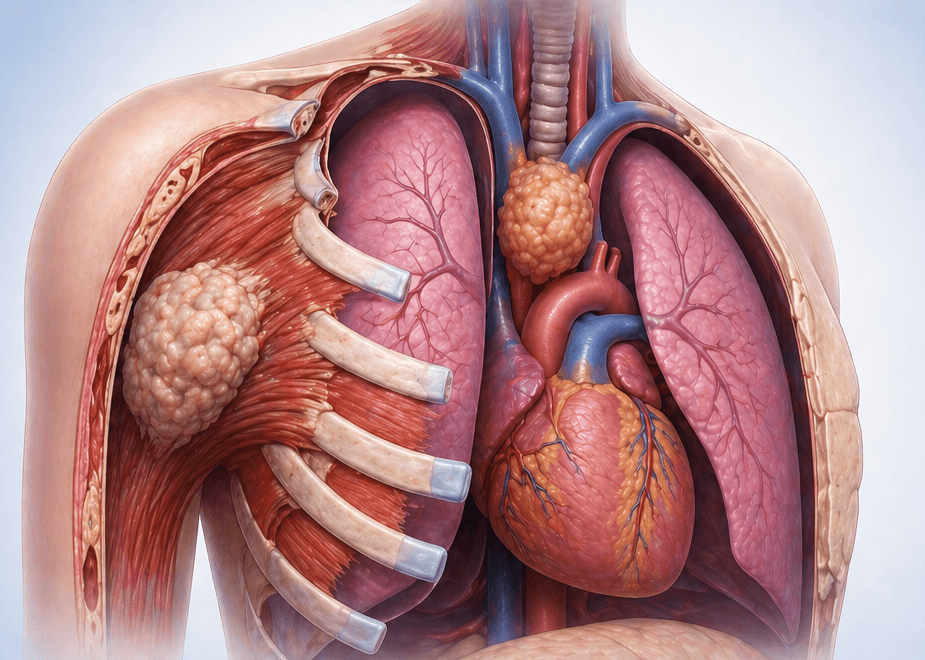
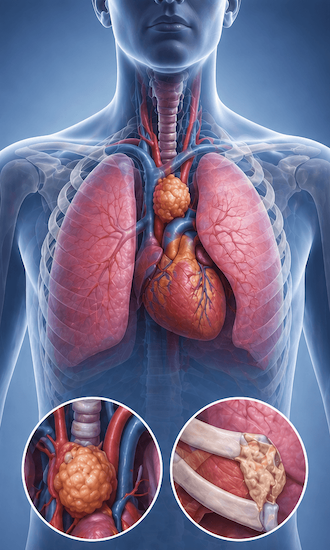
The middle mediastinum (containing the heart, trachea, and major vessels) gives rise to pericardial cysts, bronchogenic cysts, and lymph node tumours. The posterior mediastinum is the domain of neurogenic tumours, arising from nerve roots, ganglia, or the sympathetic chain, including schwannoma, neurofibroma, paraganglioma, and malignant peripheral nerve sheath tumours.
Mediastinal Germ Cell Tumours
Germ cell tumours (GCTs) of the mediastinum arise from primordial germ cells that failed to migrate to the gonads during embryogenesis. They most commonly occur in young men in the anterior mediastinum. Mature teratomas, cystic tumours containing hair, teeth, sebum, and other differentiated tissues, are benign and cured by surgical excision. Malignant GCTs (seminomas and non-seminomatous GCTs) are aggressive but highly chemosensitive; surgery plays a crucial role in removing residual masses after chemotherapy.
Mediastinal Cysts
Bronchogenic cysts arise from aberrant budding of the primitive foregut and contain respiratory epithelium. Pericardial cysts are benign outpouchings of the pericardium, most commonly found at the right cardiophrenic angle. Oesophageal duplication cysts, neurenteric cysts, and thoracic duct cysts are other mediastinal cystic lesions. While often asymptomatic, cysts may cause compression, infection, or rupture, and most surgeons recommend excision to confirm the diagnosis and prevent complications.
Neurogenic Tumours of the Posterior Mediastinum
Posterior mediastinal neurogenic tumours are among the most common mediastinal tumours in adults, usually presenting as well-defined paravertebral masses on imaging. Schwannomas and neurofibromas are typically benign and amenable to complete VATS excision. Dumbbell tumours, with intraspinal extension through a neural foramen, require combined neurosurgical and thoracic surgical approach. Malignant peripheral nerve sheath tumours and neuroblastoma/ganglioneuroblastoma in children are aggressive and require multimodal treatment.
Mediastinal Large B-Cell Lymphoma
Chest Wall Tumours
Benign chest wall tumours include fibrous dysplasia, osteochondroma, and chondroma (the most common benign chest wall tumour, arising from costal cartilage).
Surgical Treatment and Chest Wall Reconstruction
Reconstruction uses prosthetic materials, polypropylene mesh, titanium rib plates, methylmethacrylate composites, combined with local or free muscle flaps (latissimus dorsi, pectoralis major, rectus abdominis, serratus anterior) and skin grafts or flaps as needed. Complex reconstructions are performed in collaboration with plastic and reconstructive surgeons. For sternal resections, titanium plate sternal reconstruction systems allow stable and durable chest wall repair.
Complex Mediastinal or Chest Wall Tumour?
Book Appointment
+91-9920024001
9920024001