Thymoma & Myasthenia Gravis

Surgical removal of the thymus gland, transforming outcomes in chest tumours and autoimmune disease

The thymus gland, located in the anterior mediastinum (front part of the chest), is the source of two important and inter-related surgical conditions: thymoma, the most common anterior mediastinal tumour, and myasthenia gravis, an autoimmune neuromuscular disease in which surgical thymectomy plays a central therapeutic role. Advances in minimally invasive thoracic surgery have made thymectomy safer and more accessible than ever.

The Thymus Gland

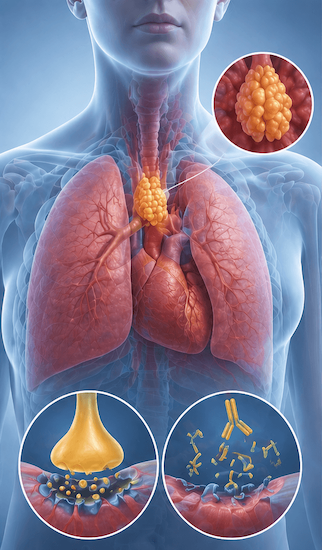
The thymus is a small lymphoid organ that sits behind the breastbone (sternum) in the anterior mediastinum. It plays a crucial role in the development and maturation of T-lymphocytes during childhood. The thymus gradually involutes (shrinks and becomes fatty) after puberty, but remnant thymic tissue persists throughout life and can give rise to both tumours and immune dysregulation.

Thymoma: The Anterior Mediastinal Tumour

Thymoma is the most common tumour of the anterior mediastinum in adults, typically presenting in the fourth to sixth decade of life. It arises from thymic epithelial cells and is classified by the WHO into types A, AB, B1, B2, B3, and thymic carcinoma, with increasing grades corresponding to more aggressive behaviour, greater invasiveness, and higher recurrence risk.

Approximately 30–40% of thymoma patients also have myasthenia gravis. Other paraneoplastic syndromes associated with thymoma include pure red cell aplasia, hypogammaglobulinaemia, and various autoimmune disorders.
Symptoms of Thymoma

Many thymomas are discovered incidentally on chest imaging done for other reasons. When symptomatic, patients present with chest pain or tightness, breathlessness (if the tumour is large), cough, superior vena cava (SVC) syndrome (facial swelling, neck vein distension, headache due to venous compression), or features of an associated paraneoplastic syndrome. Locally invasive thymomas may erode into the pericardium, pleura, or great vessels.

Myasthenia Gravis

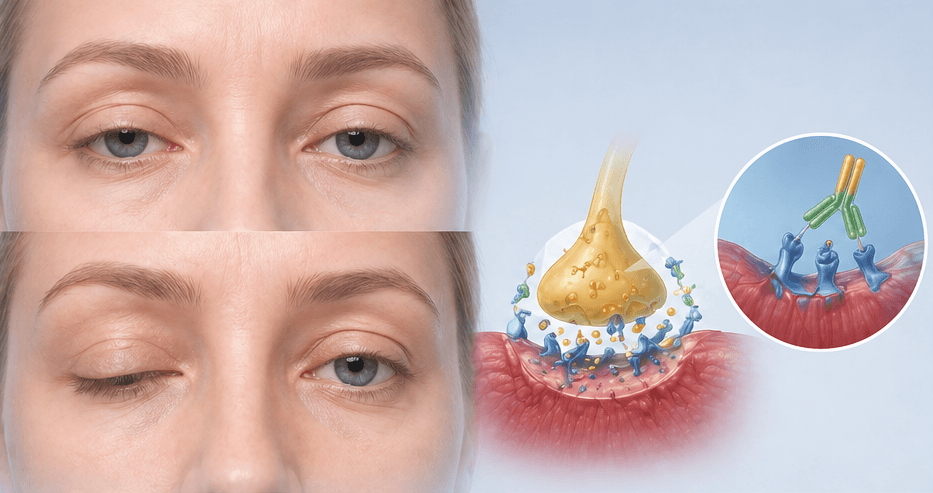
Myasthenia gravis (MG) is an autoimmune disease in which antibodies (most commonly against acetylcholine receptors) attack the neuromuscular junction, the connection point between nerves and muscles. The result is fatigable muscle weakness that worsens with activity and improves with rest. MG typically affects the ocular muscles first (causing drooping eyelids, ptosis, and double vision, diplopia), followed by the bulbar muscles (causing swallowing and speech difficulties) and eventually limb and respiratory muscles.

Respiratory crisis, myasthenic crisis, is a life-threatening emergency in which respiratory muscles fail, requiring mechanical ventilatory support. Management involves immunosuppression (pyridostigmine, steroids, azathioprine), plasma exchange or intravenous immunoglobulin for acute crises, and, crucially, thymectomy.

Why Thymectomy for Myasthenia Gravis?

The thymus is abnormal in over 75% of MG patients, either as thymoma (15%) or thymic hyperplasia (the remaining majority). Thymectomy reduces the source of autoreactive T-cells and autoantibodies, leading to sustained remission or significant improvement in symptoms in 50–80% of patients over 2–5 years. International guidelines now recommend thymectomy for all non-thymomatous MG patients aged 18–60 with generalised disease.

Surgical Treatment: Thymectomy

Complete thymectomy, removal of the entire thymus gland along with all surrounding mediastinal fat (where ectopic thymic tissue may reside), is the standard of care. For thymoma, complete surgical resection is the most important predictor of cure. Extended resection to include adjacent structures (pericardium, lung, SVC, innominate vein) may be needed for invasive thymoma.

Historically, thymectomy required median sternotomy (splitting the breastbone). Minimally invasive approaches have largely replaced this, including VATS thymectomy (via small chest wall incisions), robotic thymectomy, and transcervical approaches, offering equivalent or superior completeness of resection with dramatically less surgical trauma, shorter hospital stays, and faster return to normal life.

Staging of Thymoma (Masaoka)

Stage I: Completely encapsulated. 

Stage II: Microscopic/macroscopic capsular invasion. 

Stage III: Invasion of adjacent organs. Stage IV: Pleural/pericardial spread or distant metastasis. Surgery alone may be curative for stages I–II.

Adjuvant Treatment

Post-operative radiotherapy is considered for stages II and III thymoma. Chemotherapy is used for unresectable or metastatic disease. 


Stage IV pleural disease may still benefit from selected surgical resection combined with systemic therapy.

Thymoma or Myasthenia Gravis Diagnosis?

Early surgical consultation is key to optimal outcomes. Dr. Bhanushali specialises in minimally invasive thymectomy for both thymoma and myasthenia gravis.

Book Appointment

+91-9920024001

9920024001

What our patients say?

I had an excellent experience with Dr. Amol Bhanushali for my brother's treatment. His approach to the diagnosis and treatment was very reassuring which every patient and his/her family expect. I am thankful to ...
Read More
Vijay Kumar
I had an excellent experience with Dr. Amol Bhanushali for my brother's treatment. His approach to the diagnosis and treatment was very reassuring which every patient and his/her family expect. I am thankful to him and the entire team at the Hospital.
Vijay Kumar
I was admitted this month in Bhanushali Hospital. The nursing staff is very caring and support staff is very prompt. I received very good care from the doctors and the overall experience was excellent. The ...
Read More
Sindhu Kadam
I was admitted this month in Bhanushali Hospital. The nursing staff is very caring and support staff is very prompt. I received very good care from the doctors and the overall experience was excellent. The room was very spacious and was clean and tidy. Food provided is also nice with option for family members to buy as well.
Sindhu Kadam
One of the oldest and best hospitals of Thane. The staff are polite and helpful. You are informed well in advance if there is any change in the appointment timings. Doctors are good. They have ...
Read More
Pradeep Kumar
One of the oldest and best hospitals of Thane. The staff are polite and helpful. You are informed well in advance if there is any change in the appointment timings. Doctors are good. They have a systematic approach towards the treatment and recommend only those tests and medicines which are required. They make you absolutely comfortable and at ease. Charges are also reasonable. Overall a very satisfying experience.
Pradeep Kumar
My wife, Rekha Tejura, had been suffering from TB for the last couple of years. The infection was in her chest and abdomen both. During the treatment with anti-TB medicines,...
Read More
Hemang Tejura
My wife, Rekha Tejura, had been suffering from TB for the last couple of years. The infection was in her chest and abdomen both. During the treatment with anti-TB medicines, abdominal infection decreased but chest infection continued to persist. One of her lungs got covered with a very thick layer of pus and that side lung started to fail. At that time, we decided to go for a different doctor and heard about Dr. Amol Bhanushali. We visited him immediately and started treatment. From the very first visit itself, Dr. Bhanushali responded positively and supported us. The surgery was performed successfully using the latest technology available and my wife’s lung was saved. After the operation, she was fit and fine. I am thankful to Dr. Bhanushali for treating my wife.
Hemang Tejura
My wife, Varsha Garwa, was unwellfor nearly 10 years. She used to a keep coughing a lot and her cough used to contain blood at times. The blood went on increasing...
Read More
Rajesh Garwa
My wife, Varsha Garwa, was unwellfor nearly 10 years. She used to a keep coughing a lot and her cough used to contain blood at times. The blood went on increasing over the last few years. She had developed a fungal ball (aspergilloma) in a cavity in a part of her lung. She was treated by various doctors, however, nothing worked. By a stroke of luck, we came across Dr. Amol Bhanushali’s name. The treatment offered by Dr. Bhanushali was world class. He was very patient and polite. He explained to us everything about the disease and its treatment. He also instilled confidence in us that the surgery would be successful. The Center for Lung Surgery at Dr. Bhanushali Hospital has state-of-the-art infrastructure and has everything under one roof. My entire family is grateful to Dr. Bhanushali for treating my wife and ending her decade long misery.
Rajesh Garwa
My mother, Manjushree Patil, had been suffering from MDR-TB and was on anti-TB drugs for six years. She took treatment from different doctors but there was no respite. Through word of...
Read More
Shweta Patil
My mother, Manjushree Patil, had been suffering from MDR-TB and was on anti-TB drugs for six years. She took treatment from different doctors but there was no respite. Through word of mouth, we came to know about Dr. Amol Bhanushali. During our very first meeting with Dr. Bhanushali, he gave us detailed information about the disease and told us about the treatment. My mother’s left lung was completely destroyed by TB, and the other side was beginning to get affected too, so surgery was needed immediately. We were all very scared but Dr. Bhanushali and his team ensured that the surgery was successful and my mother got rid of TB and recovered completely. We are forever indebted to him for performing the surgery and bringing my mother out of the brink of death, thus giving her a new lease of life.
Shweta Patil